
FOUNDATION WORK IN SUFFOLK COUNTY
Foundation Installation & Repair in Suffolk County, Cracks in Your Walls. Doors That Won't Close. These Aren't Cosmetic Problems.
Foundation crack repair, footing installation, drainage correction, and settled slab repair for residential and commercial properties across Suffolk County and Nassau County. Own crews, own equipment — no subcontractors.
4.6/5 Google Rating
· BBB A+ Since 2012
· Licensed in Suffolk & Nassau County
BBB A+ Accredited
Since 2012
Dan's Best of the Best
2025 Winner
Suffolk County Licensed
Contractor License
Nassau County Licensed
Contractor License
Fully Insured
General Liability + Workers Comp
WHY FOUNDATION ISSUES HAPPEN IN SUFFOLK COUNTY
Suffolk County Soil Shifts With the Seasons, and That Movement Puts Real Stress on Your Foundation Every Year
Foundation issues in Suffolk County are common — and for specific reasons. The soil here, especially in areas like Brentwood, Bay Shore, and West Babylon, shifts with the seasons. Wet winters followed by dry summers cause the ground to expand and contract, putting real stress on your slab or footings over time.
Most homeowners don't realize how fast a small crack becomes a bigger structural problem. A hairline crack in a basement wall might not seem urgent. But water gets in. That crack grows. Concrete spalling, bowing walls, and settled slabs all start the same way — with a sign that got ignored.
We run our own crews and use our own equipment on every job. No subcontractors. When you call Fiorini Paving, the people who show up are our people — trained on our standards, accountable to us. That matters when you're trusting someone with the base of your building.
Suffolk County's building environment is specific. Sandy loam soils near the South Shore. Clay-heavy pockets further inland. Water tables that fluctuate depending on how close you are to the bay. What works in a different region doesn't always apply here. We know the soil conditions, drainage patterns, and frost depth requirements that affect how foundations behave on Long Island.
WHAT TO LOOK FOR
Six Foundation Warning Signs Suffolk County Property Owners Should Not Ignore
Horizontal Cracks in Foundation Walls
STRUCTURAL — ACT NOW
Horizontal cracks in a block or poured concrete basement wall are a serious structural warning — the wall is under lateral soil pressure. This is different from vertical cracks, which are often from shrinkage. A horizontal crack means the wall is bowing or has started to fail. Do not wait on this one.
Stair-Step Cracks in Block Walls
SETTLEMENT — ASSESS NOW
Stair-step cracks running diagonally along mortar joints in a block foundation wall point to settlement or shifting in the footing below. The pattern tells a different story than a vertical crack and requires a different approach. Not every stair-step crack is catastrophic — but none of them should be ignored.
Vertical Cracks in Poured Walls
MONITOR — WATER RISK
Vertical cracks in poured concrete walls are often from normal concrete shrinkage during curing — not always a structural concern. But water gets in through vertical cracks, and on Long Island, water that gets into a foundation crack freezes in winter and expands it further. Sealed correctly, stopped permanently.
Water Intrusion at Wall Base or Floor
DRAINAGE PROBLEM
Water entering at the base of a foundation wall or seeping through the floor slab points to drainage failure around the foundation. In Suffolk County, clay-heavy soil in areas like Brentwood and West Babylon holds water against foundations longer than sandy soils drain. The drainage cause needs to be addressed, not just the water symptom.
Bowing or Inward-Leaning Walls
STRUCTURAL FAILURE
A basement wall that leans inward has lost its structural connection against lateral soil pressure. This is one of the most serious foundation conditions — left unaddressed, the wall continues to move until it fails. We assess the severity and extent before recommending repair or full wall rebuild.
Settled or Sunken Slabs Adjacent to the Foundation
BASE MOVEMENT
Driveways, garage aprons, and patios that have settled or sunken near the foundation point to soil movement around the structure. That same movement is affecting the foundation itself — and addressing only the surface slab without checking the foundation is missing the bigger picture.
WHAT WE HANDLE
Foundation Work We Perform Across Suffolk County and Nassau County
Foundation Crack Repair
Assessment of crack type, cause, and severity before any repair begins. Vertical cracks from shrinkage get a different treatment than horizontal cracks from lateral pressure. Crack injection, waterproofing membrane, and drainage correction addressed in sequence — not just the visible crack.
Footing Installation & Underpinning
New footing installation for additions, structures, and new construction across Suffolk County. Frost depth on Long Island runs roughly 36 inches — any footing that doesn't account for that will shift. We build footings to the correct depth for local conditions.
Foundation Drainage & Waterproofing
Drainage correction around the foundation perimeter to redirect water away from the structure. The cause of most foundation water intrusion in Suffolk County is drainage — water pooling against the foundation because the grade or drainage system is directing it there. Fixing the drain source is what makes the repair last.
Foundation Slab Repair & Replacement
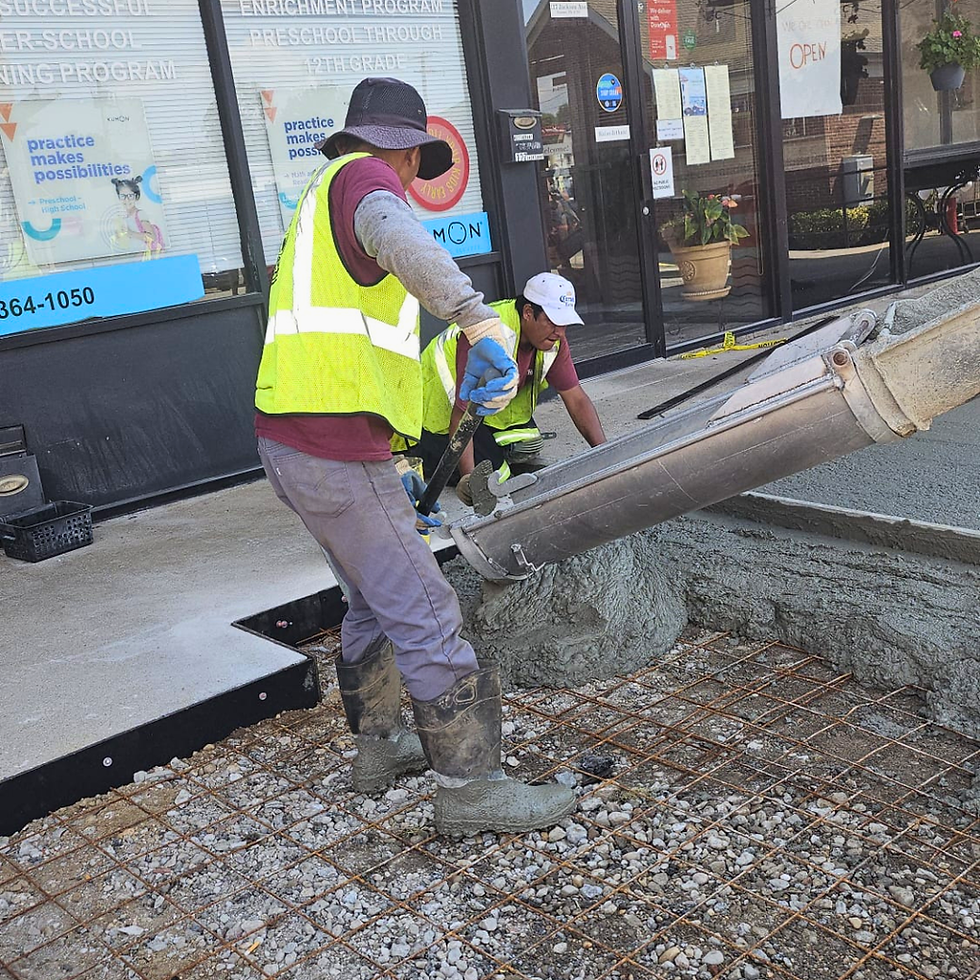
Settled, cracked, or failed foundation slabs repaired or replaced — garage slabs, basement floors, and crawlspace slabs adjacent to the structural foundation. Base assessment and moisture testing before any new pour goes down.
Why Foundation Problems in Suffolk County Are Different From Other Regions
Suffolk County's soil is not uniform and that directly affects how foundations behave here. Sandy loam soils near the South Shore — Babylon, Bay Shore, Islip — drain quickly but shift under load and during dry periods. Clay-heavy pockets further inland hold moisture for extended periods, expanding when saturated and shrinking when dry. That seasonal movement puts recurring stress on footings and foundation walls.
Water tables in coastal areas fluctuate with tidal cycles and seasonal rainfall — some properties in low-lying areas near the bay have water tables high enough to cause slab moisture issues year-round regardless of above-grade drainage.
The frost line in Suffolk County runs roughly 36 inches below grade. Any footing shallower than that is vulnerable to frost heave — the expansion of frozen ground that pushes foundations upward in winter and drops them when the ground thaws in spring.
We know all of this because we've been working in these conditions across Long Island for over 35 years. That site-specific knowledge is in every assessment we write.

WHY FIORINI PAVING
The Foundation Contractor Suffolk County Properties Trust
1971
Serving Long Island
Foundation work across Long Island since the late 1980s. We know Suffolk County's soil conditions, water table behavior, and frost depth requirements — all of which directly determine how foundation problems develop and how they need to be fixed.
2.2M
SQUARE FEET OF CONCRETE POURED ON LONG ISLAND
More than 2.2 million square feet of concrete poured across Long Island — parking lots, slabs, curbs, sidewalks, floors, retaining walls, and commercial concrete for properties of every size and type.
36
Frost depth in Suffolk County
The frost line runs roughly 36 inches below grade on Long Island. Every footing we install accounts for that. We don't apply a generic specification — we build for the actual conditions the foundation will live in.
Related Services
WHAT OUR CLIENTS SAY
4.6 out of 5 Google Reviews
Based on 10 Google reviews · Verified through Google Business Profile
Nick Russo
President, O'Keefe Court Condominium Board
2024
Fiorini Paving did an excellent job repaving the parking lot at our condo facility. As president of the board, I was involved in reviewing multiple proposals, and Fiorini impressed us with their professionalism, responsiveness, and attention to detail from start to finish. The quality of the work was top notch, and they followed up after completion to ensure everything was holding up well. We're very satisfied with the results and would highly recommend Fiorini Paving for any paving or asphalt work.
Verified Google Review
Valerie McDermott
Car Dealership, Long Island, NY
September 2021
Verified Google Review
We are a car dealership, it is a huge challenge to navigate a paving project with all the vehicles on site. Not for these guys. ABSOLUTELY A++. They were excellent at communicating exactly what needed to be done in order for the entire project to go smoothly. The parking lot looks amazing and our drain issues solved!
Matthew Vitiello
Long Island, NY
March 2021
The guys at Fiorini Paving really did a phenomenal job for us. Not only did the quality of work exceed our expectations but they were also very easy to work with throughout the whole process. I highly recommend them.
Verified Google Review
AE Ealy
Local Guide · Long Island, NY
2024
Verified Google Review
Great price. They did a very good job. The crew was very professional. Everyone was respectful. They quoted a price, gave a deadline date to complete the job and came through. Highly recommend them.
COMMON QUESTIONS
Foundation Questions, Straight Answers
It depends entirely on the type, location, and direction of the crack. Vertical cracks in poured concrete walls are often from normal shrinkage — still need to be sealed to prevent water intrusion, but not always structural. Horizontal cracks in block or poured walls are serious — they indicate lateral soil pressure and possible wall movement. Stair-step cracks in block foundations indicate settlement. We assess the crack type before recommending anything.
Many foundation cracks can be repaired from the interior using injection methods — polyurethane or epoxy injection depending on the crack type and whether it's actively leaking. Exterior excavation is sometimes required for cracks that have extensive associated drainage failure or where the exterior foundation needs membrane waterproofing. We assess the crack and determine the appropriate repair method during the site visit.
Significantly. Sandy loam near the South Shore shifts under load and during dry periods. Clay-heavy soils inland expand when wet and shrink when dry — that seasonal movement creates recurring stress on footings and walls. High water tables in coastal areas cause slab moisture issues year-round. The frost line runs 36 inches — shallow footings are vulnerable to heave every winter.
The most common cause in Suffolk County is drainage failure — water pooling against the foundation because the grade or drainage system is directing it there rather than away from it. Other causes include failed joint sealant at the wall-floor joint, cracks in the wall that allow water under hydrostatic pressure, and high water table pushing through the floor slab. We identify the source during the site assessment — treating the water symptom without finding the drainage cause means the water returns.
Yes — and we encourage property owners to get one when a foundation repair scope feels unclear or disproportionately expensive. We walk the foundation, look at the same conditions, and give you a straight read on what we see — no pressure, no upselling of repairs you don't need.
The frost line in Suffolk County runs roughly 36 inches below finished grade. Building code typically requires footings to extend below the frost line to prevent heave — the expansion of frozen ground that pushes footings upward in winter. Exact requirements vary by municipality and structure type. We research what applies to your specific address and application before any footing work begins.
READY TO GET STARTED?
Get a Free Foundation Assessment in Suffolk County
Call us directly or submit a request and we'll get back to you within one business day. Foundation crack repair, drainage correction, footing installation, and slab repair for residential and commercial properties across Suffolk County and Nassau County — own crews, straight answers, no subcontractors.
Free estimate .
No obligation .
Response within 1 business day