
CONCRETE RETAINING WALLS IN SUFFOLK COUNTY
Concrete Retaining Walls in Suffolk County, High-Load Capacity, Long Lifespan, Built for What Long Island Soil Actually Does.
Poured concrete and concrete block retaining walls for commercial, municipal, and residential properties across Suffolk County and Nassau County. Drainage designed in from the start — not addressed after the wall is built. Own crews, no subcontractors.
4.6/5 Google Rating
· BBB A+ Since 2012
· Licensed in Suffolk & Nassau County
BBB A+ Accredited
Since 2012
Dan's Best of the Best
2025 Winner
Suffolk County Licensed
Contractor License
Nassau County Licensed
Contractor License
Fully Insured
General Liability + Workers Comp
WHY CONCRETE
Soil Doesn't Stay Put on Long Island, Concrete Retaining Walls Are Built to Handle Everything Suffolk County Throws at Them
Long Island soil is not forgiving. Across Suffolk County — from Dix Hills to Holbrook — the ground is a mix of sandy loam and clay. Sandy soil drains fast but shifts under pressure. Clay holds water and expands when it freezes. A wall that can't handle both conditions will crack, lean, or fail. Concrete handles both — it doesn't flex, warp, or rot under repeated pressure cycles.
The freeze-thaw cycle is one of the biggest threats to any retaining wall on Long Island. Temperatures drop hard in January and February, then swing back above freezing in the same week. Water gets into wall joints, freezes, expands, and pushes materials apart. Timber walls split. Block walls shift. Poured concrete walls — installed correctly with proper drainage behind them — resist that movement. The mass and density give it a structural advantage that other materials simply don't match in this climate.
From a structural standpoint, poured concrete walls handle significantly higher lateral loads than modular alternatives. Hydrostatic pressure — the force water exerts against a wall from behind — builds fast during Suffolk County's heavy rain events. A properly designed concrete wall with drainage aggregate and weep holes manages that pressure without pushing the wall outward.
A well-built concrete retaining wall, installed with the right footing depth and drainage system, can last 50 years or more. Timber walls typically need replacement in 15 to 20 years. When you account for the cost of repeated repairs or full replacement, concrete is the more practical long-term choice for most residential and commercial properties on Long Island.

KNOW THE SIGNS
Six Signs Your Suffolk County Property Needs a Concrete Retaining Wall
Standing Water at the Base
DRAINAGE FAILING
When a slope loses its shape, water pools at the base instead of draining away — softening the soil further, speeding up erosion, and flooding patios, driveways, or basement entrances. Common in low-lying areas throughout Suffolk County where poor drainage compounds the problem every wet season.
Soil Pressing Against Your Foundation
FOUNDATION AT RISK
In neighborhoods like Dix Hills, where lots have more elevation change, we see yards where grading has slowly crept toward the house. Soil pressing against a foundation wall year after year creates hydrostatic pressure that can crack block foundations and push basement walls inward.
Visible Soil Movement After Rain
ACT BEFORE NEXT STORM
Dirt washing down a slope after a storm, a ridge of soil piling up against your fence, driveway, or foundation — that movement means the grade is failing. Left alone, it keeps going. Every rain event removes more material and widens the problem.
Neighbor's Runoff Now Hitting Your Property
DRAINAGE CHANGE UPSTREAM
If your neighbor recently put in a retaining wall and their runoff now comes onto your property, you may need one too. Grading changes on one lot affect adjacent lots. We handle these situations regularly across Suffolk County and can assess exactly where a wall needs to go to redirect drainage correctly.
Slope Too Steep to Use or Maintain
RECLAIM YOUR YARD
Can't mow a section without the ground shifting? Can't use a sloped yard section at all? A concrete retaining wall stops erosion and gives you flat, usable land back. That means a patio, a garden bed, or a yard you can walk across without sliding.
Cracking at Driveway Edges
SOIL UNDERNEATH MOVING
Cracking, sinking, or separation from the surrounding grade at driveway edges is a sign the soil underneath has shifted. A retaining wall along the driveway edge holds the grade in place and protects pavement from undermining — before the driveway failure itself becomes a second repair project.
WHY CONCRETE FOR LONG ISLAND CONDITIONS
What Makes Concrete the Right Retaining Wall Material for Suffolk County Properties
Freeze-Thaw Resistance
Poured concrete walls resist the movement that destroys timber and shifts block. Water gets into joints in other materials, freezes, expands, and pushes them apart. Concrete's mass and density resist that movement — installed correctly with proper drainage, it handles Long Island's hardest winters without structural compromise.
Hydrostatic Pressure Resistance
Poured concrete walls handle significantly higher lateral loads than modular alternatives. Properly designed with drainage aggregate and weep holes, concrete manages the water pressure that builds behind any retaining wall during Suffolk County's heavy nor'easters and spring rain events.
Coastal Exposure Durability
Properties near the Great South Bay and Long Island Sound deal with salt air that accelerates corrosion in metal fasteners and degrades wood quickly. Concrete is non-porous when properly mixed and sealed — it doesn't absorb salt the way timber does. For waterfront and near-water properties, concrete holds its integrity season after season.
50-Year Lifespan
A well-built concrete retaining wall, installed with the right footing depth and drainage system, lasts 50 years or more without major intervention. Timber walls need replacement in 15 to 20 years. Modular block walls can shift and require re-leveling. When you account for the full cost of ownership, concrete is the practical long-term choice.
What Fiorini Paving Does Before Breaking Ground, Why This Step Determines Whether the Wall Lasts
A concrete retaining wall that fails doesn't just look bad. It can shift soil, damage your foundation, and create a genuine safety hazard. Before our crew touches a single shovel, we do the groundwork that prevents those problems.
We start by walking the site — reading the slope, the soil type, and how water moves across your yard. Suffolk County has a mix of sandy loam near the shoreline and heavier clay soils further inland. Sandy soil drains fast but shifts under load. Clay holds water and expands. Knowing which one you have changes how we design the wall, how deep we set the footing, and where we place drainage.
We look at what sits above the wall. A flat lawn puts one kind of pressure on a wall. A driveway, a shed, or a deck puts a completely different load behind it. If there's a surcharge load — something heavy sitting near the top of the slope — we factor that into wall thickness and footing depth before we order material.
Drainage planning happens at this stage — not after. Water pressure behind a retaining wall is one of the most common reasons walls crack and bow, and it's entirely preventable when drainage is designed in from the start. We call 811 before any digging begins. We confirm permit requirements for your specific municipality. When our crew arrives on day one, every variable is already accounted for.
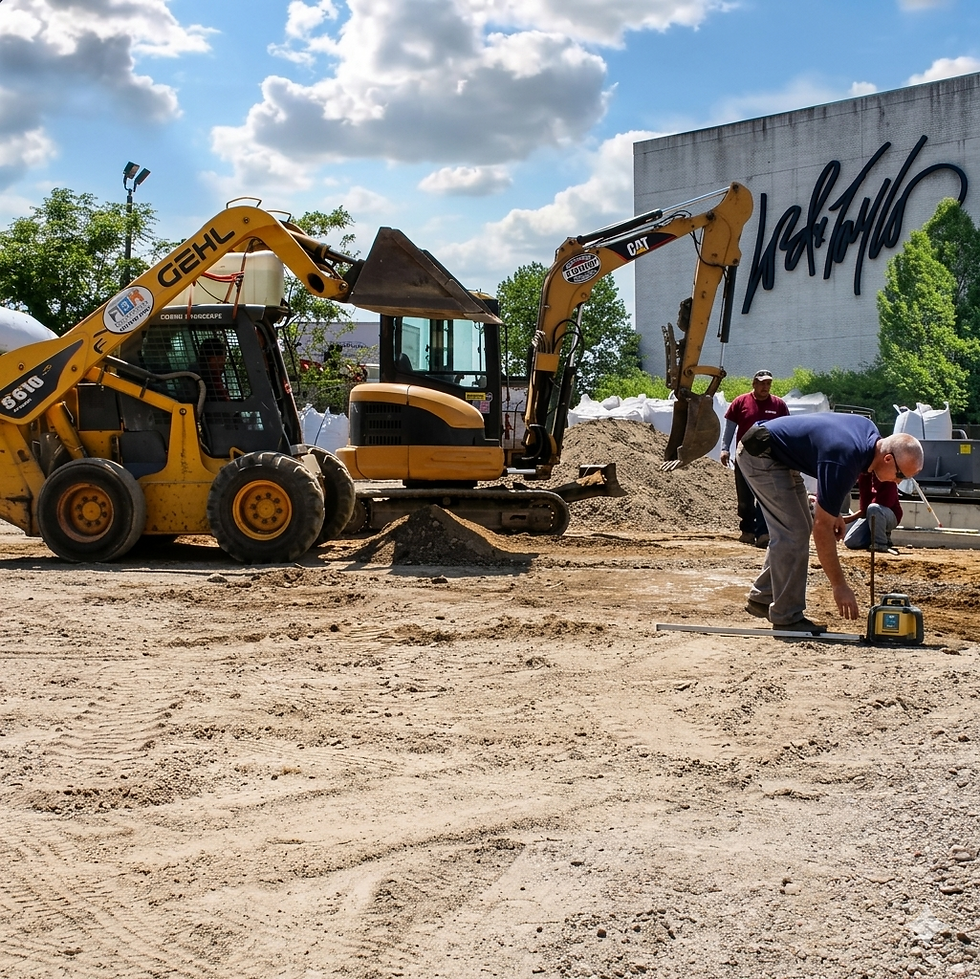
FEATURED PROJECT
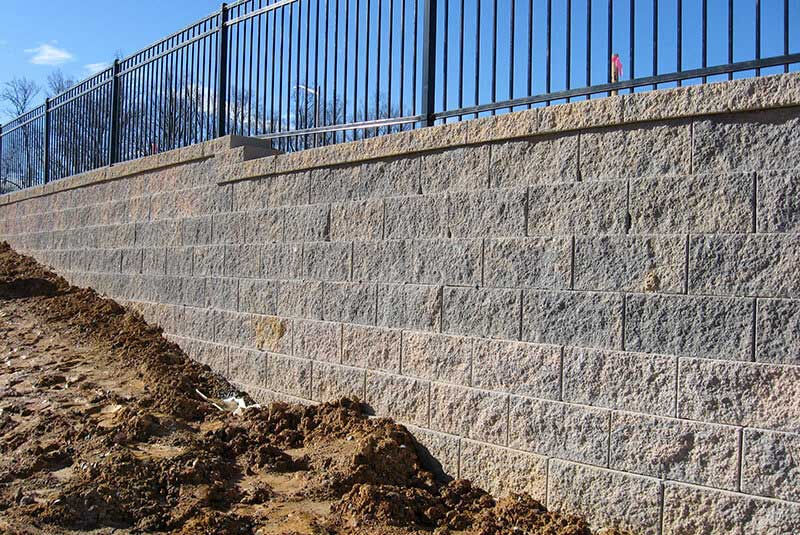
Concrete block retaining wall — commercial property, Long Island, NY
Commercial Property Retaining Wall, Street-Facing Masonry Block Installation, Long Island, NY
LOCATION
Long Island, NY — Commercial Property
WALL TYPE
Concrete Masonry Unit (CMU) — Split-Face Block
WALL HEIGHT
4.5 feet finished height
WALL LENGTH
68 linear feet
COURSES
5 standard courses + solid cap course throughout
BASE SPEC
18" wide concrete footing below frost line · Compacted aggregate base · Drainage pipe and gravel backfill full length
SERVICES
Excavation · Footing Pour · CMU Block Installation · Drainage Pipe & Gravel Backfill · Cap Course Installation · Sidewalk Interface Restoration
This street-facing commercial property wall in Long Island had two problems working against it simultaneously: a grade that had been slowly failing for years and an original timber wall that had completely rotted through at the base — no longer holding back the slope it was built to retain.
The slope sat between the property's front yard and the public sidewalk. Every significant rain event was washing topsoil down and onto the walkway — a maintenance issue that had become a liability. The property owner needed a permanent structural solution that matched the professional appearance of the surrounding commercial corridor.
Fiorini removed the failed timber wall in full, excavated to frost-depth for a continuous concrete footing, and installed a split-face concrete masonry unit wall in five standard courses with a solid cap course running the full 68-foot length. Drainage pipe and compacted gravel backfill were installed behind the full wall run before any block was set above grade — the drainage infrastructure is what makes the wall perform through Long Island's wet springs and hard winters.
The finished wall presents a clean, gray masonry face to the street — professional grade, built to hold through decades of freeze-thaw cycles, and designed from the footing up to eliminate the slope failure that had been damaging the property's frontage for years.
WHY FIORINI PAVING
The Concrete Retaining Wall Contractor Suffolk County Properties Trust
50+
Year concrete wall lifespan when built correctly
Sealcoating commercial lots and driveways across Suffolk County since the late 1980s. We know exactly what Long Island UV, freeze-thaw cycles, and road salt do to asphalt — and when and how to protect against it.
275+
Retaining Walls Built & Repaired
275-plus retaining walls installed and repaired across Long Island — concrete block, poured concrete, natural stone, and masonry walls for residential, commercial, and municipal properties across Suffolk County and Nassau County.
1,500+
Properties Served Across Long Island
From commercial parking lots and industrial facilities to HOA communities and substantial residential properties — 1,500-plus Long Island properties served with our own crews and our own equipment since the late 1980s.

WHAT OUR CLIENTS SAY
4.6 out of 5 Google Reviews
Based on 10 Google reviews · Verified through Google Business Profile
Nick Russo
President, O'Keefe Court Condominium Board
2024
Fiorini Paving did an excellent job repaving the parking lot at our condo facility. As president of the board, I was involved in reviewing multiple proposals, and Fiorini impressed us with their professionalism, responsiveness, and attention to detail from start to finish. The quality of the work was top notch, and they followed up after completion to ensure everything was holding up well. We're very satisfied with the results and would highly recommend Fiorini Paving for any paving or asphalt work.
Verified Google Review
Valerie McDermott
Car Dealership, Long Island, NY
September 2021
Verified Google Review
We are a car dealership, it is a huge challenge to navigate a paving project with all the vehicles on site. Not for these guys. ABSOLUTELY A++. They were excellent at communicating exactly what needed to be done in order for the entire project to go smoothly. The parking lot looks amazing and our drain issues solved!
Matthew Vitiello
Long Island, NY
March 2021
The guys at Fiorini Paving really did a phenomenal job for us. Not only did the quality of work exceed our expectations but they were also very easy to work with throughout the whole process. I highly recommend them.
Verified Google Review
AE Ealy
Local Guide · Long Island, NY
2024
Verified Google Review
Great price. They did a very good job. The crew was very professional. Everyone was respectful. They quoted a price, gave a deadline date to complete the job and came through. Highly recommend them.
COMMON QUESTIONS
Concrete Retaining Wall Questions, Straight Answers
Most retaining walls over four feet tall require a building permit in Suffolk County. Local municipalities like Babylon and Islip have their own rules too, so the height limit can vary by town. We handle the permit research as part of every project. Getting this right from the start protects your property value and avoids fines or forced removal later.
The freeze-thaw cycle is one of the biggest threats to retaining walls on Long Island. Water gets into joints, freezes, expands, and pushes materials apart. Poured concrete walls hold up against that movement better than timber or block. The key is proper drainage behind the wall — without it, water builds up, freezes, and creates pressure that even a solid wall can't handle over time.
Most residential retaining wall projects in Suffolk County take two to five days from start to finish. The timeline depends on wall length, height, and how much excavation the slope requires. After the pour, concrete needs time to cure before backfilling. We walk you through the full schedule before work begins.
Yes — a properly built concrete retaining wall can redirect water and stop it from pooling in the wrong places. The wall itself holds the slope, but the drainage system behind it does the water management work. We install gravel backfill and drainage pipe behind every wall. This is especially important on Long Island, where sandy soil drains fast but loses shape when saturated.
We plan the work to protect what's already there. Before any excavation starts, we mark off beds, roots, and pavement edges we need to work around. In areas like Dix Hills where mature trees and established landscaping are common, we pay close attention to root zones. The goal is a wall that solves the problem without creating new ones.
Poured concrete walls are formed and cast in place — continuous, monolithic, and best for taller walls with high lateral loads. Concrete block (CMU) walls are built course by course from manufactured masonry units — faster to construct on most residential applications and can be finished in various textures including split-face. Both need proper footing depth and drainage. We recommend the right approach based on your wall height, load, and site conditions.

READY TO GET STARTED?
Get a Free Concrete Retaining Wall Estimate in Suffolk County
Call us directly or submit an estimate request and we'll get back to you within one business day. Concrete retaining walls for commercial, municipal, and residential properties across Suffolk County and Nassau County — drainage designed in from the start, own crews, no subcontractors.
Free estimate .
No obligation .
Response within 1 business day