
INDUSTRIAL FACILITY, HAUPPAUGE INDUSTRIAL PARK
Hauppauge Industrial Park, When Standard Commercial Spec Isn't Enough, You Build to What the Facility Actually Carries
📍 Hauppauge Industrial Park, NY
🏗 65,000 sq ft + Concrete Loading Apron
🚛 Heavy-Load Industrial Specification
✓ Own Crew · No Subcontractors
65,000
sq ft Parking Area
210
Parking Spaces
3
Catch Basins Replaced
Concrete
Loading Dock Spec
Industrial
Asphalt Section
THE CHALLENGE
20 Years of Heavy Truck Traffic on a Base That Was Never Built to Handle It, and a Loading Dock That Should Never Have Been Asphalt
The Hauppauge Industrial Park is the largest industrial park in the Northeast outside of New York City. The facilities that operate there range from light industrial to full distribution — and the parking lots and access roads serving those facilities carry loads that standard commercial pavement specifications simply aren't designed for.
This particular distribution facility had a parking lot at end of service life. Twenty-plus years of daily semi-truck traffic on a base that had been spec'd for a much lighter load profile than the facility ultimately required. Widespread alligator cracking across the main vehicle lanes. Three failing catch basins that had been allowing water to work against the base for years — clay-heavy soil in this part of central Suffolk County holds moisture far longer than sandy soils near the shore, and every rain event that wasn't draining properly was accelerating the base failure.
The loading dock apron was a separate problem with a different answer. The existing asphalt surface at the loading dock had been deteriorating for years — not from load failure alone, but from daily petroleum and hydraulic fluid exposure from delivery vehicles that idle and drip at docks continuously. Asphalt breaks down under that exposure. The binders soften. The surface deforms. The right material for a loading dock with that exposure profile is concrete — not a heavier grade of asphalt, but a fundamentally different material that resists chemical infiltration rather than absorbing it.
The answer, in our case, is always the same: we plan the work sequence first, then we start.


.webp)
THE APPROACH
Different Zones. Different Materials. One Contractor for the Entire Scope.
The scope for this project was assessed in zones — because not every part of this facility had the same problems or the same solution.
Parking lot zones carrying standard employee and visitor traffic received a heavier asphalt pavement section than would be specified for a retail or office property — 3 inches of surface course over 4 inches of binder course on a rebuilt aggregate base. The traffic lanes serving the loading dock approach received an even heavier section to account for the axle loads of fully loaded delivery trucks making repeated turning movements at low speed — the most damaging traffic pattern any pavement encounters.
The loading dock apron itself was converted from asphalt to concrete. Six inches of reinforced concrete over a compacted aggregate base — designed for the actual load and chemical exposure the dock receives daily. A concrete loading apron in that application will outlast the asphalt alternative by a decade under comparable conditions.
Before any paving began, all three catch basins were excavated and replaced. Drainage grades throughout the lot were corrected to address the standing water patterns that had been identified during the site assessment. The drainage infrastructure had to be operational and correct before a square foot of new asphalt went down — because laying new pavement over an undrained base in clay-heavy Hauppauge soil is just purchasing a second round of the same failure at a future date.
The facility stayed operational throughout the project. Phased sequencing kept dock access and employee parking functional at all times.
PROJECT SPECIFICATIONS
Full Project Details
LOCATION
Hauppauge Industrial Park, Suffolk County, NY
Client Type
Industrial Distribution Facility
Total Area
65,000 sq ft (asphalt) + loading dock apron (concrete)
Parking Capacity
210 spaces
Asphalt Section — Standard Zones
3" surface course · 4" binder course · rebuilt aggregate base
Asphalt Section — Loading Approach
Heavier spec — additional binder course for truck loads
Loading Dock Apron
6" reinforced concrete — petroleum exposure rated
Catch Basins Replaced
3 precast concrete structures
Drainage
Full grade correction throughout lot
Facility Operations
Maintained throughout — phased access
Crew
Self-performed — Fiorini own crew and equipment
Why Material Selection at Industrial Facilities Isn't a Preference It's a Performance Decision
Contractors who apply standard commercial asphalt specifications to industrial facilities are setting up a failure. The loads are different. The chemical exposure is different. The drainage conditions are different. Getting the material decision wrong at the start means the surface fails faster than it should, and the facility is facing another reconstruction project in ten years instead of thirty.
Fiorini's approach to industrial paving starts with the site assessment — specifically the traffic load analysis, the chemical exposure zones, and the drainage conditions for that specific facility. The specification follows the assessment. Not the other way around.

Services Used on This Project
Commercial Parking Lot Paving
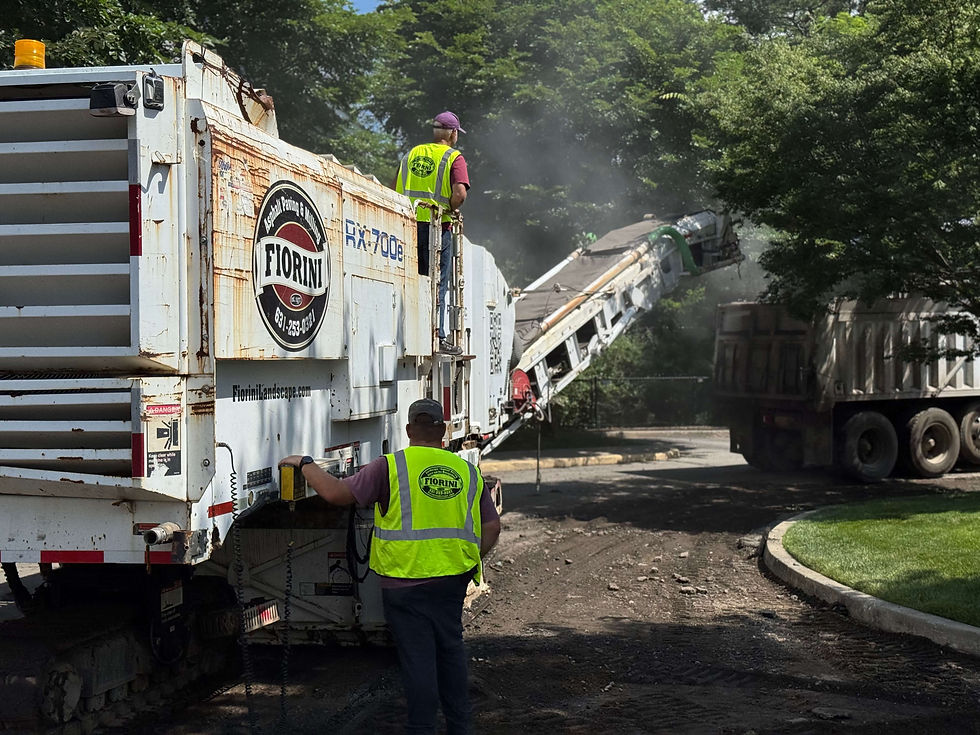
Concrete Slabs & Loading Areas
Catch Basin Installation