
MULTI-FAMILY RESIDENTIAL COMPLEX
Bay Shore, 48 Units, 68 Parking Spaces, and a Drainage Problem That Was Destroying the Surface From Below
📍 Bay Shore, Suffolk County, NY
🏗 68 spaces · 1,800 LF driveway
🚛 Heavy-Load Industrial Specification
✓ Own Crew · No Subcontractors
48
Unit Complex
68
Parking Spaces
1,800 LF
Shared Driveways
4
Catch Basins Replaced
5 days
Project Duration
THE CHALLENGE
South Shore Soil Doesn't Drain the Way Inland Properties Do. Build Without Accounting for That and the Pavement Fails From the Bottom Up.
Bay Shore sits on the Great South Bay, and that location defines every paving project we do here. The soil in Bay Shore and surrounding South Shore communities holds moisture differently than the sandy soils in drier inland areas of Suffolk County. Water moves slowly through this ground. When a parking lot or driveway system is built without accounting for that, the moisture works against the pavement base continuously — not just after heavy rains, but through the sustained ground moisture conditions that define this area seasonally.
This 48-unit residential complex had a parking and driveway system that was at end of service life for a specific reason: the original drainage design was inadequate for South Shore conditions. Four catch basins throughout the complex were undersized and improperly spaced for the volume of surface water this site generates during rain events. The result was chronic standing water after every significant storm — and that standing water was doing exactly what standing water does to pavement: softening the base course, creating depressions, and accelerating the cracking and surface failure that had been spreading across the complex for years.
Surface replacement alone wouldn't have solved this. New asphalt over an undrained base on Bay Shore soil is just a new surface on an old failure waiting to re-emerge. The drainage problem had to be resolved first — and resolved correctly for this specific site's conditions.


THE APPROACH
Drainage First, Surface Second, and a Paver Entryway That Gives the Complex a Finished First Impression
The project scope was built in sequence — drainage correction before surface replacement, because the sequence matters.
All four catch basins were excavated and replaced with correctly sized precast concrete structures, positioned to the revised drainage grade plan. The surface grades throughout the parking area and driveway runs were corrected during the milling operation to direct water toward the new basin locations rather than away from them. This grade correction work is invisible in the finished surface — but it's the difference between a lot that drains and one that doesn't.
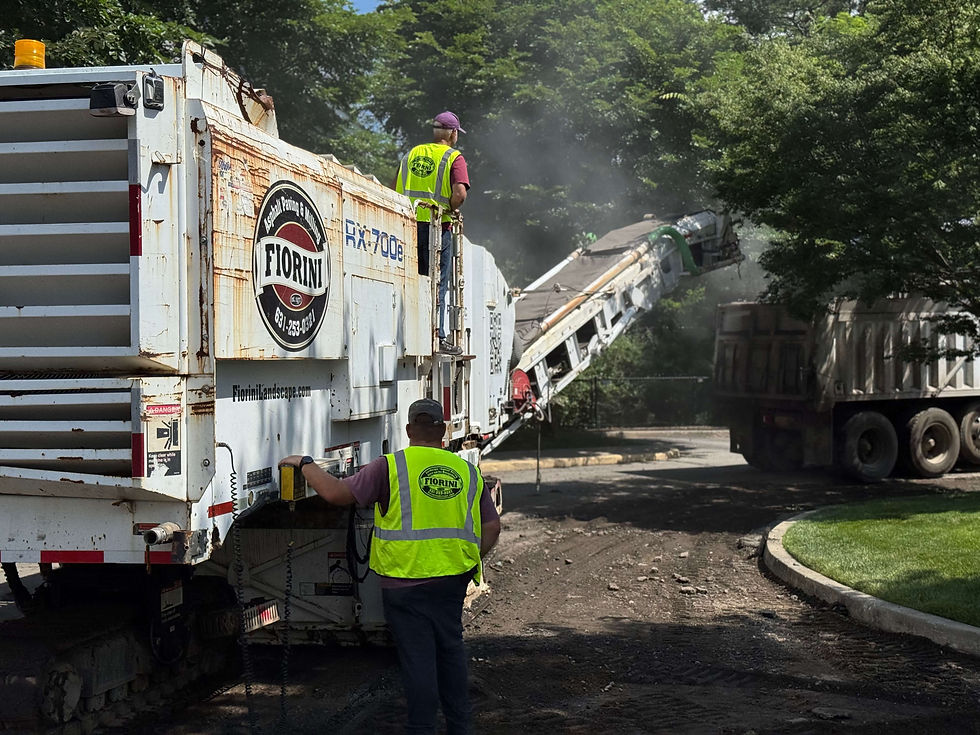
Once drainage was confirmed correct, milling proceeded across the full parking area and all 1,800 linear feet of shared driveways. New asphalt was laid to the correct section for a residential complex with mixed passenger vehicle and light service vehicle traffic — 3-inch surface course over 4-inch binder course on a compacted and drainage-corrected base.
The entryway was a separate scope item that the property management requested alongside the repaving project. Interlocking concrete pavers in a charcoal blend with a contrasting border course — installed at the complex entrance to create a visual differentiation between the entryway approach and the standard asphalt driveway system beyond it. A practical amenity improvement that added meaningful curb appeal at a scope that made sense within the overall project.
Five days total. Resident access maintained throughout — no section closed for more than the hours required to lay and cure each pass.
PROJECT SPECIFICATIONS
Full Project Details
LOCATION
Bay Shore, Suffolk County, NY
Client Type
Multi-Family Residential Complex — HOA/Property Management
Total Units
48
Parking Capacity
68
Shared Driveway
1,800 linear feet
Pavement Section
3" surface course · 4" binder course
Drainage
Full grade correction — 4 catch basin replacements
Entryway
Interlocking concrete pavers, charcoal blend, contrasting border course
Resident Access
Maintained throughout — phased by section
Project Duration
5 days
Crew
Self-performed — Fiorini own crew and equipment