
ASPHALT REPAIR & PATCHING IN SUFFOLK COUNTY
Asphalt Repair & Patching in Suffolk County, Fix It Now Before It Costs Ten Times More.
Pothole repair, crack patching, edge work, and surface restoration for commercial parking lots, driveways, and municipal properties across Suffolk County and Nassau County. Own crews, own equipment — no subcontractors.
4.6/5 Google Rating
· BBB A+ Since 2012
· Licensed in Suffolk & Nassau County
BBB A+ Accredited
Since 2012
Dan's Best of the Best
2025 Winner
Suffolk County Licensed
Contractor License
Nassau County Licensed
Contractor License
Fully Insured
General Liability + Workers Comp
THE PROBLEM WITH WAITING
Small Asphalt Problems Become Big Ones Fast, Especially in Suffolk County
Freeze-thaw winters crack pavement from the inside out. Summer heat softens and shifts it. A hairline crack in October is a pothole by March — and a pothole left through another winter becomes a base failure that no amount of patching will fix.
The window to repair asphalt cheaply is short on Long Island. Catch damage early and a targeted repair costs a fraction of what resurfacing or replacement will. Miss that window — let one season pass, then another — and what started as a $500 crack fill becomes a $15,000 repaving job.
We handle asphalt repair and patching across Suffolk County and Nassau County with our own crews and equipment. No subcontractors. Every repair job starts with a site walk — we look at the full picture before we price anything. The cause of the damage matters as much as the damage itself. Fixing the surface without addressing what caused the failure is a temporary patch at best.
Not sure whether what you're seeing needs immediate attention or can wait? Call us at (631) 643-2443 and we'll come out and tell you straight.

KNOW THE SIGNS
Four Types of Asphalt Damage, What Each One Means and How Urgent It Is
Not all cracks are equal. Knowing the difference tells you exactly how urgent the repair is — and what kind of fix it needs.
Slow Drainage Toward the Drain
HIGH — ACT NOW
A web of interconnected cracks that looks like reptile skin. This pattern means the base layer is failing beneath the surface. Do not ignore it. Alligator cracking limited to one section can still be repaired — but once it spreads across the majority of the surface, replacement is the only fix.
Hairline Cracks
LOW — ACT THIS SEASON
Thin surface cracks from UV exposure and age. The least urgent but the most important to catch early. Seal these now and they stay small. Leave them through a Long Island winter and water gets in, freezes, expands, and turns a seal job into a patching job.
Visible Cracks in Basin Walls or Frame
MODERATE — ASSESS BASE
Grooves or low spots where the pavement has sunk or shifted. Common in high-traffic areas and commercial lots with heavy vehicle loads. In Brentwood and Bay Shore, this shows up frequently in older driveways where the original base was never compacted correctly. Water collects in those depressions and accelerates the damage cycle.
Sinkholes or Soft Spots Near the Basin
STRUCTURAL FAILURE
Spongy ground around the drain means the basin wall or surrounding pipe has failed. Water is escaping underground instead of flowing through the outlet. This type of failure gets worse with every rain — common on older commercial properties in Hauppauge and Melville where basins haven't been touched in decades.
Potholes Are Not a Surface Problem — They're a Structural One
By the time a pothole forms, the base material beneath it has already washed out or collapsed. Water gets into a crack, freezes over a Long Island winter, and expands — pushing the asphalt apart from below. The surface collapses into the void. What you see on top is the last stage of a process that started below ground months earlier.
If you have one pothole, check the surrounding area carefully. More are usually forming nearby — the same water infiltration that caused the first one is working on the base throughout that section. A single pothole repair that doesn't address the surrounding pavement condition and drainage is likely to be followed by more calls to a paving contractor next spring.
Potholes on a commercial parking lot are also a liability exposure — a customer trips, a vehicle gets damaged, and that problem lands on you as the property owner. Repair is not optional when the safety of your customers, tenants, or residents is involved.
DO A BASIC INSPECTION
Walk Your Property Twice a Year, Here's What to Look For
Warning signs to check for:
Hairline cracks — especially around edges and utility covers
Alligator cracking — web pattern anywhere on the surface
Standing water after rain — same spots every time
Potholes or soft spots that flex under foot or vehicle weight
Raveling — surface feels rough, aggregate coming loose
Fading color — gray pavement means brittle, dried-out binder
Heaving near tree roots — especially in older neighborhoods
Edge crumbling along curb lines or driveway borders
When to inspect:
Do this twice a year — once in spring after the ground thaws, and once in fall before the freeze sets in. Those are the windows where catching damage early means a repair job instead of a replacement bill.
Fading color gets overlooked. Fresh asphalt is dark black. As it ages and oxidizes it turns gray — and gray pavement is brittle pavement. The binder that holds everything together has dried out. When you see gray, cracking has already started or is about to.
Check around utility covers, tree roots, and areas where vehicles turn repeatedly — these spots take more stress than the rest of the surface and fail first.
HOW WE DO IT
What Happens When the Fiorini Crew Arrives at Your Suffolk County Property
01
Full Surface Assessment
The work starts before a single tool comes off the truck. We walk the damaged area with you — looking at the size of the failing section, what caused it, and how far the damage has spread beneath the surface. A pothole in a Deer Park driveway often tells a different story than a crack running along a commercial lot in Hauppauge. The cause matters.
02
Saw-Cut Clean Boundaries
We cut beyond the visible damage — not just to the edge of the crack or pothole. This is where most repair jobs fail. Leave compromised asphalt at the edges and the new material has nothing solid to bond to. Our crew uses saw-cutting equipment to make clean, straight lines. That clean edge is what holds the repair together long-term.
03
Base Repair & Compaction
After cutting, we remove damaged asphalt down to stable base material. If the base is soft or saturated — which Suffolk County freeze-thaw cycles and heavy spring rain cause regularly — we address it before any new asphalt goes down. We compact the base with plate compactors sized for the job. A hand-tamped repair on a high-traffic parking lot will not hold up.
04
Hot Mix & Finish
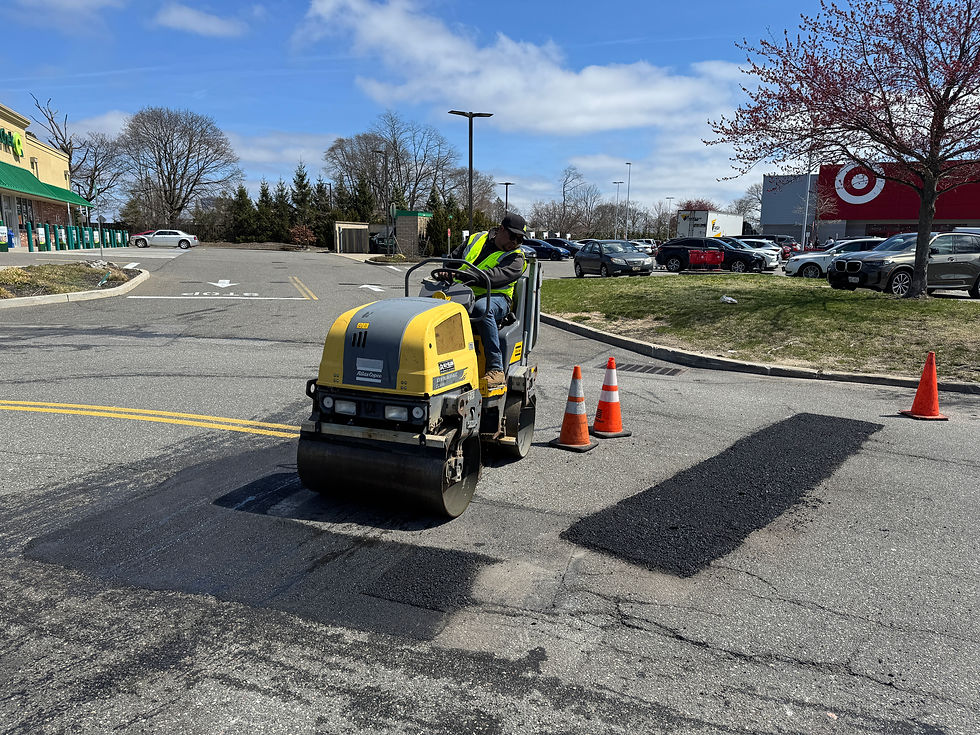
Hot mix asphalt goes in at the right temperature and in the correct lifts — thick repairs require multiple passes. We monitor mix temperature from the plant to the ground. After placement, we compact with a roller to match surrounding surface grade. Flush — not raised, not sunken. A raised patch catches snowplow blades. A sunken patch collects water and starts the damage cycle over again.
When Repair Is the Right Call — and When It Isn't
Repair is the right move when the base layer is still solid. Surface damage — cracks under an inch wide, isolated potholes, edge crumbling, alligator cracking limited to one section — can all be fixed without replacing the whole surface. We see this regularly on driveways 10 to 15 years old in Bay Shore, Islip, and Smithtown with scattered damage but a stable foundation underneath.
The window for repair closes when damage spreads. Alligator cracking covering more than 25-30 percent of a surface, deep base failure visible through large depressions, or asphalt crumbling across the full width — those are replacement scenarios.
One detail specific to Long Island: clay-heavy soils in parts of Suffolk County shift seasonally. That movement can push up sections of asphalt from below, creating heaving or uneven surfaces. This isn't always a sign of full failure — sometimes the base just needs to be re-graded and the surface layer replaced in that zone. Our crews know this soil behavior and factor it into every repair assessment.

WHY FIORINI PAVING
The Installation Contractor That Does It Right the First Time
35+
Years on Long Island
Installing asphalt across Long Island since the late 1980s. We've worked in every soil condition on the island — sandy South Shore soils, clay-heavy Brentwood ground, and fill soil that needs full excavation before anything goes down. That experience is in every scope we write.
180+
Miles of Asphalt Laid on Long Island
More than 180 miles of asphalt laid across Suffolk County and Nassau County — commercial parking lots, driveways, access roads, municipal paths, and private community roads. Every mile with our own equipment and our own crew.
1,500+
Properties Served Across Long Island
From commercial parking lots and industrial facilities to HOA communities and substantial residential properties — 1,500-plus Long Island properties served with our own crews and our own equipment since the late 1980s.
FEATURED PROJECT
West Babylon Commercial Asphalt Repair — Winter Conditions
.jpg)
.jpg)
.jpeg)
LOCATION
West Babylon, Suffolk County, NY
CLIENT TYPE
Commercial Property — Road / Parking Area Repair
PROJECT TYPE
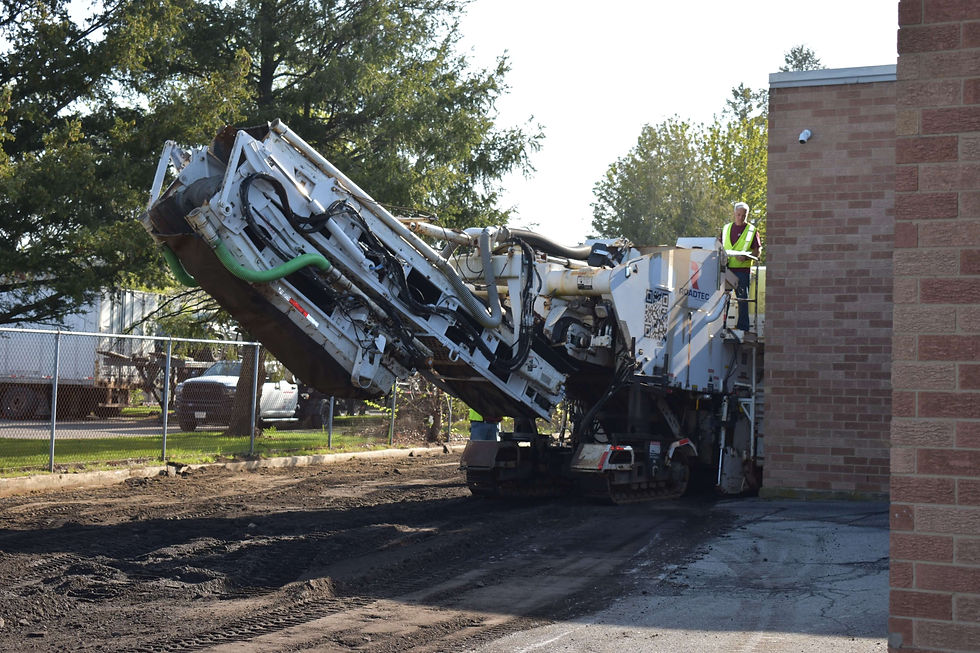
Full-Depth Commercial Asphalt Milling & Repair — Winter Conditions
SERVICES
Full Milling · Base Inspection · Hot-Mix Asphalt Repaving · Edge Repair · Same-Day Completion
CONDITION
End-of-season deterioration — potholes, crumbling surface, edge breakdown
COMPLETED
Cold-weather operation — winter scheduling
Commercial asphalt repair in winter conditions is not a job every contractor will schedule — cold temperatures compress the paving window, hot-mix asphalt cools faster, and mat temperature must be managed carefully to achieve correct compaction before the mix stiffens.
We scheduled and completed this West Babylon commercial repair in winter conditions because the client couldn't wait until spring. The surface had reached a point where deterioration was creating a safety issue and liability exposure — potholes and crumbling edges on an active commercial surface don't improve over winter. They get worse with every additional freeze-thaw cycle.
Our crew milled the deteriorated surface sections to a consistent depth, inspected the base, and relaid hot-mix asphalt within the correct temperature window for winter paving conditions. All patching was saw-cut to clean boundaries before milling — no cold joints, no ragged edges that compromise the bond between new and existing asphalt.
The repair was completed same-day — property back in use, liability addressed, base protected from further freeze-thaw damage.
Related Asphalt Services
WHAT OUR CLIENTS SAY
4.6 out of 5 Google Reviews
Based on 10 Google reviews · Verified through Google Business Profile
Nick Russo
President, O'Keefe Court Condominium Board
2024
Fiorini Paving did an excellent job repaving the parking lot at our condo facility. As president of the board, I was involved in reviewing multiple proposals, and Fiorini impressed us with their professionalism, responsiveness, and attention to detail from start to finish. The quality of the work was top notch, and they followed up after completion to ensure everything was holding up well. We're very satisfied with the results and would highly recommend Fiorini Paving for any paving or asphalt work.
Verified Google Review
Valerie McDermott
Car Dealership, Long Island, NY
September 2021
Verified Google Review
We are a car dealership, it is a huge challenge to navigate a paving project with all the vehicles on site. Not for these guys. ABSOLUTELY A++. They were excellent at communicating exactly what needed to be done in order for the entire project to go smoothly. The parking lot looks amazing and our drain issues solved!
Matthew Vitiello
Long Island, NY
March 2021
The guys at Fiorini Paving really did a phenomenal job for us. Not only did the quality of work exceed our expectations but they were also very easy to work with throughout the whole process. I highly recommend them.
Verified Google Review
AE Ealy
Local Guide · Long Island, NY
2024
Verified Google Review
Great price. They did a very good job. The crew was very professional. Everyone was respectful. They quoted a price, gave a deadline date to complete the job and came through. Highly recommend them.
COMMON QUESTIONS
Asphalt Repair Questions, Straight Answers
Suffolk County's freeze-thaw cycles are the biggest enemy of asphalt on Long Island. Water gets into small cracks, freezes, expands, and pushes the pavement apart from inside. That turns a hairline crack into a pothole fast. The best repair windows are spring after the ground thaws and fall before the first freeze. Miss those windows and a simple repair becomes a replacement job.
If your base layer is still solid, repair is almost always the right call. Surface damage — cracks under an inch wide, isolated potholes, edge crumbling — can all be fixed without replacing the whole driveway. The problem is when the base has failed — that's when repair won't hold. We check the base on every job before recommending anything. You won't get pushed toward replacement if you don't need one.
We walk the full surface with you and look at cracks, drainage, soft spots, and the base layer condition. We check around utility covers, garage aprons, and areas with tree roots or heavy traffic. You get a straight answer on what needs to be done now and what can wait. No pressure, no upselling. We use our own crews and equipment — no subcontractors showing up with unfamiliar materials.
Yes — tree roots are one of the most common causes of cracking and heaving we see across Suffolk County, especially in older neighborhoods with mature trees close to the driveway. As roots grow, they push up through the base and surface, creating raised sections and cracks that get worse every season. Catching root damage early makes repair much more straightforward than waiting until the heaving spreads.
Alligator cracking — the web pattern that looks like reptile skin — means the base layer underneath is starting to fail. It's more serious than regular surface cracks, but not always too late to repair. If the damage is limited to one section, we can often address it without replacing everything. The key is acting before the pattern spreads across the full surface and the base collapses completely.
Yes — sectional repair is a common approach for commercial lots where damage is localized. High-traffic areas near entrances and drive lanes wear faster than perimeter stalls. We can repair those sections without shutting down the whole property — and we work around your business hours when the job allows.
Absolutely — a pothole or uneven surface that causes a customer to trip or damages a vehicle is a problem that lands directly on you as the property owner. Commercial properties in Suffolk County — strip malls, medical offices, apartment complexes — carry real liability exposure when pavement is deteriorating. Keeping your lot in safe condition isn't just about appearance. It's about the safety of everyone who uses your property.

READY TO GET STARTED?
Get a Free Asphalt Repair Estimate in Suffolk County
Call us directly or submit an estimate request and we'll get back to you within one business day. Potholes, cracks, edge damage, and surface failures — we fix it right the first time with our own crews and equipment across Suffolk County and Nassau County.
Free estimate .
No obligation .
Response within 1 business day