ASPHALT INSTALLATION IN SUFFOLK COUNTY
Asphalt Installation in Suffolk County, Built on the Right Base, the First Time.
New asphalt installation for commercial parking lots, residential driveways, private roads, and municipal properties across Suffolk County and Nassau County. Proper excavation, proper base, proper compaction — no shortcuts.
4.6/5 Google Rating
· BBB A+ Since 2012
· Licensed in Suffolk & Nassau County
BBB A+ Accredited
Since 2012
Dan's Best of the Best
2025 Winner
Suffolk County Licensed
Contractor License
Nassau County Licensed
Contractor License
Fully Insured
General Liability + Workers Comp
WHY MOST ASPHALT FAILS EARLY
A Lot of Driveways and Parking Lots in Suffolk County Fail Early, Not Because of Bad Asphalt, Because of Bad Prep
Bad preparation is the reason we've repaved driveways in Suffolk County that were only three or four years old. The original installer skipped base work, rushed the compaction, or laid asphalt over unstable subgrade. The surface looked fine for a season or two — then Long Island winters did what they always do to asphalt without a solid foundation underneath.
Every proper asphalt installation starts below the surface. We inspect what's there — old cracked asphalt, compacted gravel, or bare soil. We look at drainage patterns, soft spots, and how water moves across the site. Poor drainage is one of the biggest reasons pavement fails in Suffolk County — water gets under the surface, freezes in winter, and breaks the base apart from below.
We've worked across every soil condition on Long Island — sandy soils near the South Shore that shift under load, clay-heavy soils in Brentwood that hold moisture for weeks after a rainstorm, and fill soil that needs to be dug out entirely and replaced with clean, compacted base material before a single ton of asphalt goes down.
Every step of a Fiorini installation is done in the correct sequence, with the correct equipment, by our own crew. Skip a step or rush a phase and the surface shows it within a season or two. Do it right the first time and it lasts 20 years.

WHO WE INSTALL FOR
Four Types of Asphalt Installation Projects We Handle Across Long Island
New installation, full replacement, private roads, municipal contracts — different projects, same crew, same standards.
Asphalt Installation & Paving
New construction pours and full replacement for commercial parking lots of any size. We spec the asphalt section — base depth, binder course, and surface course thickness — based on the actual vehicles your lot carries. A retail strip in Hicksville handles different loads than a distribution facility in Brentwood. We design for both.
Residential Driveways
New driveway installation and full replacement for residential properties across Suffolk and Nassau County. Sandy soil in West Islip, clay-heavy ground in Bay Shore, tree roots in older Huntington neighborhoods — we've seen every Long Island residential condition and build accordingly.
Private Roads & HOA Communities
Private road installation and full repaving for gated communities, housing complexes, and HOA properties across Long Island. Phased to keep access open for residents throughout the job. One crew, one contact, full accountability from first cut to final rolling.
Municipal & Road Construction
Municipal road paving and new construction for government and public works contracts across Suffolk County and Nassau County. Licensed, bonded, and insured for municipal work. We hold the equipment capacity and crew depth to execute county-scale paving projects.
THE TECHNICAL DETAIL
What a Proper Asphalt Installation Involves, Step by Step
This is what separates an installation that lasts 20 years from one that needs attention after two winters. Every step performed by our own crew.
01
Full Site Assessment & Drainage Mapping
We inspect the existing surface and what's beneath it — old asphalt, compacted gravel, or bare soil. We map drainage patterns, identify soft spots, and assess how water moves across the site during and after rain. In Suffolk County, poor drainage is the single biggest cause of early pavement failure — we address it before anything else. You get a complete picture of the job before we price it.
02
Excavation to Stable Subgrade
We remove everything that isn't stable — old failed asphalt, compromised base, saturated or unsuitable soil. In areas like Brentwood, we've encountered fill soil that holds moisture for weeks after rain. That material gets dug out and replaced with clean, compacted base aggregate — dense-grade material that locks together under load and doesn't shift with Suffolk County's freeze-thaw cycles.
03
Subgrade Grading & Drainage Slope
After excavation, we grade the subbase to direct water away from structures and toward proper drainage points. This is where the drainage pattern of your finished surface is set. A driveway that pools water near a foundation is a grading failure — and fixing it after asphalt is down means tearing it up and starting over. We get it right before base material goes in.
04
Base Compaction in Lifts
Base compaction is where most crews cut corners. We compact the aggregate base in lifts — each layer compacted before the next one goes down — using our own plate compactors and rollers. This builds a stable, load-bearing platform that won't shift under vehicle traffic. Suffolk County soil varies: sandy soil near the South Shore needs different compaction passes than heavier inland soils. We adjust for both.
05
Hot-Mix Asphalt — Mix Design & Lift Thickness
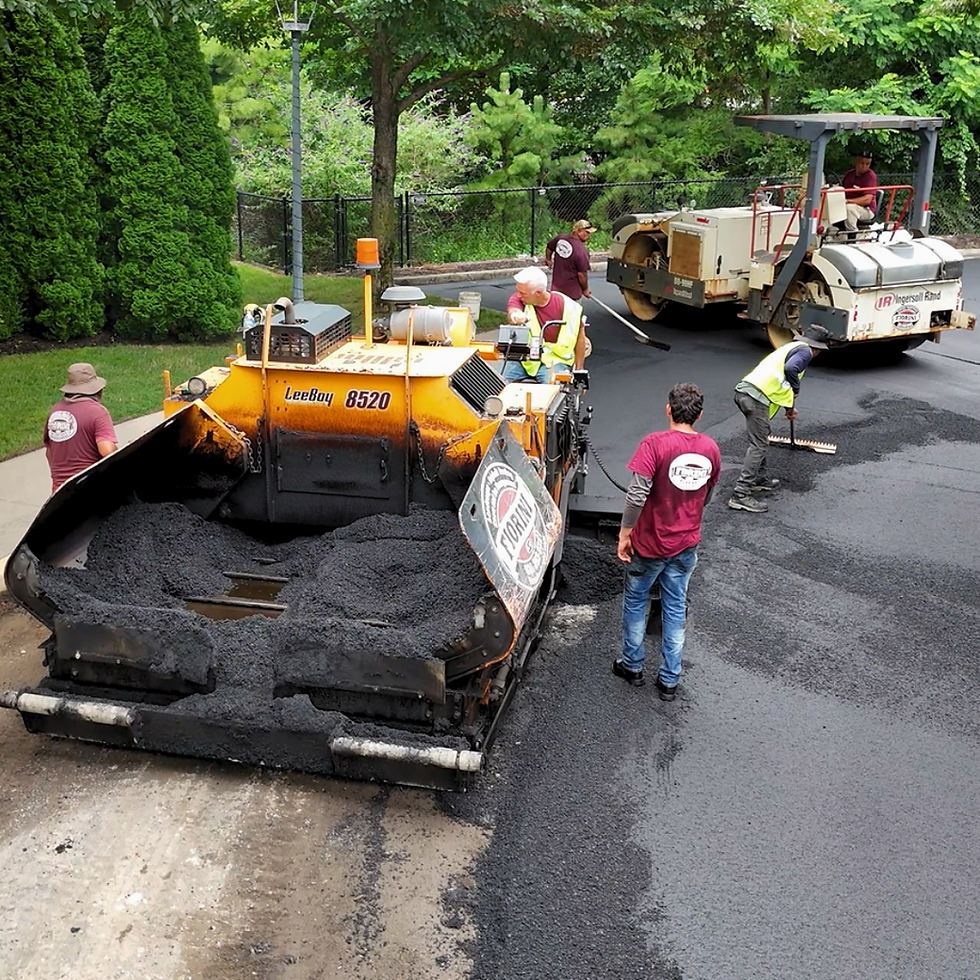
We use hot-mix asphalt suited to the application. Driveways, commercial lots, and municipal roads each require different mix designs and surface course thicknesses. A light-duty residential driveway is not specced the same as a commercial lot carrying daily delivery trucks. Hot-mix must be placed and compacted within a specific temperature window — our own crew and equipment mean we control that timing from plant delivery to final rolling. No waiting on a subcontractor.
06
Final Rolling, Edges & Cure Time
Multiple passes with a steel drum roller achieve proper density — the single most important factor in how the surface resists rutting, cracking, and water penetration over time. Edges are compacted and tied into existing curbing or edge restraints where needed. Open edges chip and crumble without support — we compact and protect every edge. Fresh asphalt needs 24-48 hours before vehicle traffic, and 6-12 months to reach full curing hardness. We give you a specific timeline based on the day's conditions before we leave.
When Repair or Resurfacing Won't Cut It — and Full Installation Is the Right Call
Not every damaged surface needs full installation. But when two or more of these conditions exist at the same time, repair and resurfacing are temporary fixes at best.
Alligator cracking across the surface — that web of interconnected fractures — means the base layer underneath has failed. Sealing or patching over it delays the real problem by a season, maybe two. When we see that pattern on a commercial lot in Ronkonkoma or a driveway in Huntington, the surface needs full removal and new installation — not a patch.
Soft spots that flex under foot or vehicle weight are a structural failure, not a cosmetic one. No surface repair fixes a failed sub-base. The asphalt comes up, the base gets rebuilt correctly, and new material goes down.
Standing water pooling in the same spots after every rain means the surface grade has failed or the base has shifted. Laying new asphalt over a drainage problem just buries it — it returns within a season. Full installation lets us correct the grade before new asphalt goes down.
Pavement 20+ years old showing multiple failure types — cracking, raveling, drainage issues, and soft spots together — has reached end of service life. Continued maintenance costs more over time than starting fresh.
WHO WE INSTALL FOR
Four Types of Asphalt Installation Projects We Handle Across Long Island
New installation, full replacement, private roads, municipal contracts — different projects, same crew, same standards.
Clear the Entire Surface
Move every vehicle, dumpster, trailer, and piece of equipment off the driveway or parking area before we arrive. Our equipment needs full access to every inch of the surface — even a car parked at the edge forces us to leave a gap or rework a section. Confirm with tenants or neighbors the day before.
Mark Underground Utilities
Call 811 before any digging or grading work — this is a New York State legal requirement. Utility lines, irrigation pipes, and drainage runs need to be flagged. If you have a sprinkler system, know where the heads are located. Our grading equipment can clip a head or crush a shallow line if nobody marks it first.
Clear the Work Area Edges
Pull back any edging material, mulch, or landscaping stones at least a foot from the paving line. In neighborhoods like Dix Hills and Commack where driveways border garden beds, this is critical — it gives us a clean border to work to and protects your landscaping from equipment contact.
Check Drainage Before We Arrive
Walk the area after a rainstorm and note any standing water spots. Tell us before the job starts — not after. We can adjust the grade during installation to direct water where it should go. Catching a drainage issue on the front end costs nothing. Fixing it after asphalt is down and cured means tearing it up and starting over.
WHY FIORINI PAVING
The Installation Contractor That Does It Right the First Time
35+
Years on Long Island
Installing asphalt across Long Island since the late 1980s. We've worked in every soil condition on the island — sandy South Shore soils, clay-heavy Brentwood ground, and fill soil that needs full excavation before anything goes down. That experience is in every scope we write.
180+
Miles of Asphalt Laid on Long Island
More than 180 miles of asphalt laid across Suffolk County and Nassau County — commercial parking lots, driveways, access roads, municipal paths, and private community roads. Every mile with our own equipment and our own crew.
1,500+
Properties Served Across Long Island
From commercial parking lots and industrial facilities to HOA communities and substantial residential properties — 1,500-plus Long Island properties served with our own crews and our own equipment since the late 1980s.
What Comes Before and After Installation
Asphalt Milling
When the failed surface needs to be removed before new installation — our milling machines grind down to a precise depth, leaving the sound base intact.


READY TO GET STARTED?
Get a Free Asphalt Installation Estimate in Suffolk County
Call us directly or submit an estimate request and we'll get back to you within one business day. New installation, full replacement, private roads, and municipal contracts — self-performed with our own crews and equipment across Suffolk County and Nassau County.
Free estimate .
No obligation .
Response within 1 business day
WHAT OUR CLIENTS SAY
4.6 out of 5 Google Reviews
Based on 10 Google reviews · Verified through Google Business Profile
Nick Russo
President, O'Keefe Court Condominium Board
2024
Fiorini Paving did an excellent job repaving the parking lot at our condo facility. As president of the board, I was involved in reviewing multiple proposals, and Fiorini impressed us with their professionalism, responsiveness, and attention to detail from start to finish. The quality of the work was top notch, and they followed up after completion to ensure everything was holding up well. We're very satisfied with the results and would highly recommend Fiorini Paving for any paving or asphalt work.
Verified Google Review
Valerie McDermott
Car Dealership, Long Island, NY
September 2021
Verified Google Review
We are a car dealership, it is a huge challenge to navigate a paving project with all the vehicles on site. Not for these guys. ABSOLUTELY A++. They were excellent at communicating exactly what needed to be done in order for the entire project to go smoothly. The parking lot looks amazing and our drain issues solved!
Matthew Vitiello
Long Island, NY
March 2021
The guys at Fiorini Paving really did a phenomenal job for us. Not only did the quality of work exceed our expectations but they were also very easy to work with throughout the whole process. I highly recommend them.
Verified Google Review
AE Ealy
Local Guide · Long Island, NY
2024
Verified Google Review
Great price. They did a very good job. The crew was very professional. Everyone was respectful. They quoted a price, gave a deadline date to complete the job and came through. Highly recommend them.